
The equivalence between BTU and frigories is straightforward: 1 BTU equals 0.252 frigories. To convert from BTU to frigories, multiply the BTU by 0.252, and for the reverse conversion, multiply the frigories by 3.97. Thus, a 12,000 BTU unit has a cooling capacity of approximately 3,024 frigories per hour, which in practice is rounded to 3,000.
This conversion solves a very common problem when comparing air conditioners: some manufacturers list power in BTU, others in frigories, and others in kilowatts. In this guide you have the exact formula, the ready-to-use equivalence table, the reason for these units, and how all this applies when you choose a portable industrial air conditioning unit whose datasheet comes in BTU.
The BTU to Frigories Conversion Formula
The relationship between both units is constant, so a simple multiplication is all you need. These are the two operations you need:
- From BTU to frigories: BTU × 0.252 = frigories/h
- From frigories to BTU: frigories × 3.97 = BTU/h
An example with the most common unit on the market, the 12,000 BTU: 12,000 × 0.252 = 3,024 frigories. And conversely, if an installer recommends 4,500 frigories, that would be 4,500 × 3.97 = 17,865 BTU, meaning an 18,000 BTU unit.
In day-to-day industry practice, many round 1 BTU to 0.25 frigories (or divide BTU by 4) for quick mental calculation. It’s a valid approximation to get an idea, but the precise factor is 0.252, and at higher capacities the difference starts to become noticeable.
BTU to Frigories Equivalence Table
This is the quick reference with the most common standardized capacities. Manufacturers set capacities in multiples of 3,000 BTU, which is why you’ll always see the same increments. The kilowatt column is added, which is how power appears on the European energy label.
| BTU/h | Frigories/h | Power (kW) |
|---|---|---|
| 7,000 BTU | 1,764 fg | 2.05 kW |
| 9,000 BTU | 2,268 fg | 2.64 kW |
| 12,000 BTU | 3,024 fg | 3.52 kW |
| 18,000 BTU | 4,536 fg | 5.28 kW |
| 24,000 BTU | 6,048 fg | 7.03 kW |
12,000 BTU (one “ton of refrigeration” in industry jargon) is the market reference point. The rest of the increments derive from there: 9,000 BTU is three-quarters of a ton, 18,000 is one and a half tons, and 24,000 is two tons.
How Many Frigories Are 12,000 BTU?
12,000 BTU is 3,024 frigories (12,000 × 0.252), which in practice is rounded to 3,000. It’s one of the most versatile capacities: it covers a living room or meeting room of about 25 to 30 m² well under normal conditions, with standard ceiling height and neutral orientation.
What Are BTU and What Are Frigories
Both are thermal energy units that measure the same thing: the capacity of a unit to extract heat from a space. The difference is geographical origin. The BTU (British Thermal Unit) is the amount of energy needed to raise the temperature of one pound of water by one degree Fahrenheit, and is used in the English-speaking world and in Asian manufacturer catalogs. The frigorie equals one kilocalorie of cold (the energy to lower the temperature of one kilogram of water by one degree) and is the traditional unit in Spain.
That’s why the conversion matters: units sold in Spain often come with datasheets in BTU, while the installer and user think in frigories. Knowing how to convert from one to the other prevents comparing two units incorrectly and ending up with one that falls short or is oversized.
From BTU and Frigories to Watts: The Third Unit
One piece is missing to complete the puzzle: the kilowatt, which is the International System unit and the one that appears on the energy label. The equivalences are:
- 1 frigorie/h = 1.163 thermal watts
- 1,000 frigories = 1.16 kW
- 1 BTU/h = 0.293 thermal watts
It’s important not to confuse thermal power with electrical consumption. BTU, frigories, and thermal kW measure the unit’s cooling capacity. Actual power consumption from the grid is something else and is always lower, because it depends on efficiency (the SEER value): an A+++ class inverter unit can generate between 6 and 8 units of cooling for each unit of electricity it consumes.

Why This Conversion Matters When Choosing a Unit
Getting the conversion right is what prevents buying the wrong unit. A unit with less power than needed works continuously under strain, doesn’t reach the target temperature, and drives up consumption. An oversized one cools too quickly, dehumidifies poorly, and wears out with short on-off cycles. The BTU datasheet is useless if you don’t translate it to what your space actually needs in frigories.
The power figure is just the starting point. The final figure depends on factors that the conversion doesn’t capture: ceiling height, orientation, insulation, hours of sunlight, or heat generated by machines and people. In industrial environments this weighs much more than in a home, and that’s why the calculation changes; you can see it in detail in the guide on how many frigories you need for an industrial warehouse, where the coefficients are considerably higher than residential ones.
Convert the Datasheet with Blizzcool
Once you know how to translate BTU to frigories, the next step is to choose a unit that actually delivers that power under your working conditions. Blizzcool is the industrial air conditioning brand of INTEC Suministros Industriales, specializing in advising on the real coverage of each unit before purchase rather than selling the most expensive model.
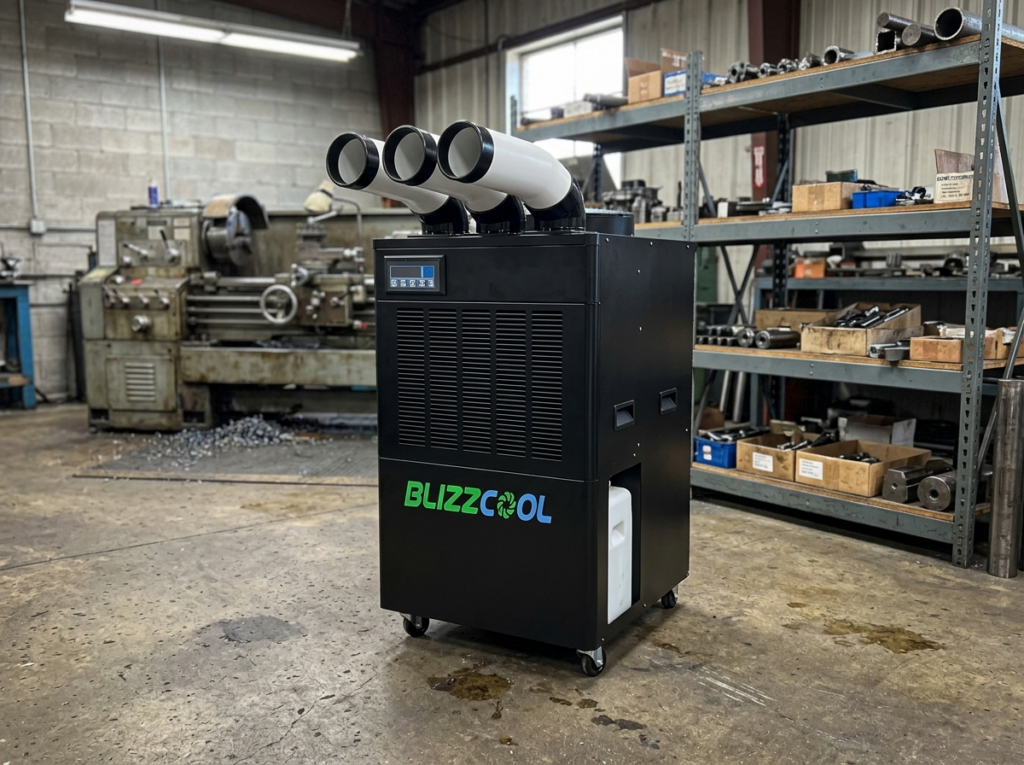
Its portable industrial air conditioning range goes from the 2,000 frigories of the AC-1900/1 (about 7,940 BTU) to the 5,300 frigories of the AC-5300/3 (about 21,000 BTU), with power expressed directly in frigories so you don’t have to do the conversion yourself. If you’re unsure between models, the technical team calculates what power actually covers your space based on square meters, activity, and the temperature you experience, and the Renewal Plan allows replacing old units with a discount.