
An industrial warehouse needs between 150 and 250 frigories per square meter, not the 100fg/m² applied in residential spaces. The difference is determined by ceiling height, thermal load from machinery, building envelope insulation, and whether the space remains open or closed during working hours. However, if the goal is not to cool the entire warehouse but to protect workers at their workstations, the calculation is radically different: a portable industrial air conditioner of 3,500-5,300 frigories is enough to effectively cool one or two fixed workstations, without needing to size the entire warehouse.
Why the 100 Frigories per m² Rule Doesn’t Work in a Warehouse
The 100fg/m² rule is designed for spaces with 2.5-meter ceilings, well insulated, without internal heat sources, and with moderate occupancy. An industrial warehouse violates all those assumptions at once:
- Height: industrial warehouses have ceilings from 5 to 12 meters. The greater the air volume, the more power needed. Above 4 meters in height, the calculation must be done by cubic meters, not square meters.
- Operating machinery: a press, milling machine, furnace, or welder generates constant heat that adds to the thermal load. Every 1 kW of electrical power consumed by a machine generates approximately 860 frigories/hour of residual heat that must be extracted.
- Metal enclosures: metal sheeting accumulates and transfers heat much more efficiently than insulated brick or concrete in a residential building. A warehouse with an uninsulated metal roof can double the thermal load compared to a well-constructed warehouse.
- Open doors: many warehouses operate with industrial doors open, eliminating any possibility of maintaining cold air inside with a centralized system.
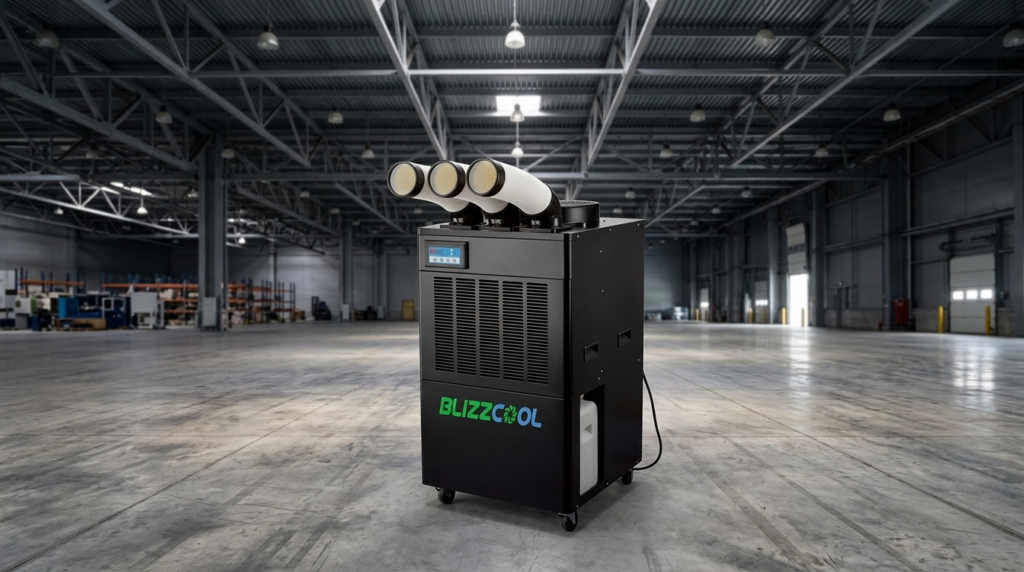
Frigories per m² Table for Industrial Warehouse
| Warehouse Type | Frigories/m² | Equivalent in kW/m² |
|---|---|---|
| Well-insulated warehouse, no heavy machinery, closed doors | 120 – 150 fg/m² | 0.14 – 0.17 kW/m² |
| Standard warehouse, light machinery, occasional openings | 150 – 200 fg/m² | 0.17 – 0.23 kW/m² |
| Warehouse with heavy machinery, welding, furnaces, or forging | 200 – 300 fg/m² | 0.23 – 0.35 kW/m² |
| Semi-open warehouse or with frequently open doors | Calculation not valid for fixed system | Use spot cooler per workstation |
To convert frigories to kW: divide frigories by 860. To convert to BTU: multiply frigories by 3.97.
How to Calculate Your Warehouse’s Frigories Step by Step
The base formula for an industrial warehouse is: m² × height (m) × thermal load factor. The factor ranges from 50 to 80 depending on warehouse type (equivalent to calculating by cubic meters with an adjusted coefficient).
Practical example: 300 m² machining warehouse with 6-meter height and operating CNC machinery.
- Volume: 300 m² × 6 m = 1,800 m³
- Load factor (moderate machinery): 65
- Total frigories: 1,800 × 65 = 117,000 fg/h
- In kW: 117,000 ÷ 860 = ~136 kW cooling capacity
That is the sizing to cool the entire warehouse. It requires a large-scale centralized installation.
The Calculation No One Does: Cool the Workstation, Not the Warehouse
In most workshops and manufacturing warehouses, the real problem is not that the entire warehouse is at 40°C: it’s that the worker at their welding, machining, or assembly station works at temperatures that affect their performance and safety. The difference is important because it completely changes the sizing.
An industrial spot cooler of 5,300 frigories/hour directs an airflow of 900 m³/h of cold air directly to the workstation, creating a comfort zone with a 4 to 6-meter radius. In a workshop with five workers at fixed stations, five units of this type solve each worker’s thermal problem at a fraction of the cost of cooling the entire 300 m² warehouse. Installation is zero: plug them in and they work the same day.
This approach doesn’t work if the production process requires temperature and humidity control throughout the entire space (food, pharmaceutical, precision electronics). For those cases, complete warehouse sizing is unavoidable. But for machining workshops, welding, metal carpentry, or logistics, cooling the workstation is almost always the fastest, cheapest, and most flexible solution.
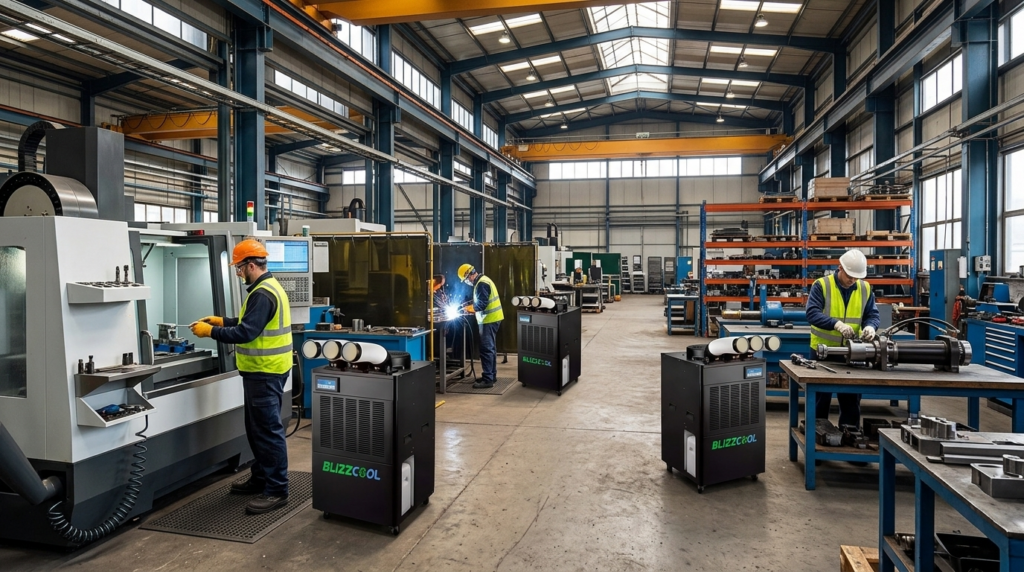
Blizzcool: Power for the Workstation That Needs It Most
The Blizzcool spot cooler range covers from 1,900 to 5,300 frigories/hour, with one or three directional air ducts to concentrate cold air at the exact workstation. No installation, no certified technician, no waiting weeks. If you already have old equipment, the Renewal Plan allows you to upgrade them at a discount. To calculate how many units you need based on the workstations in your warehouse, you can inquire directly through the contact form.
