
Royal Decree 486/1997 establishes that the temperature in enclosed workplaces must be between 17 and 27°C for sedentary office work and between 14 and 25°C for light work. For moderate or heavy work, common in industry, the decree does not set a specific number and requires risk assessment. These values are set out in Annex III, along with humidity and ventilation limits.
This is the reference standard in Spain for environmental conditions at work. In this guide you will see what Annex III of RD 486/1997 says exactly, what temperature and humidity ranges it requires, why there is no fixed limit in industry, how it relates to Royal Decree-law 4/2023 on extreme heat, and what you can do to ensure your warehouse or workshop complies.
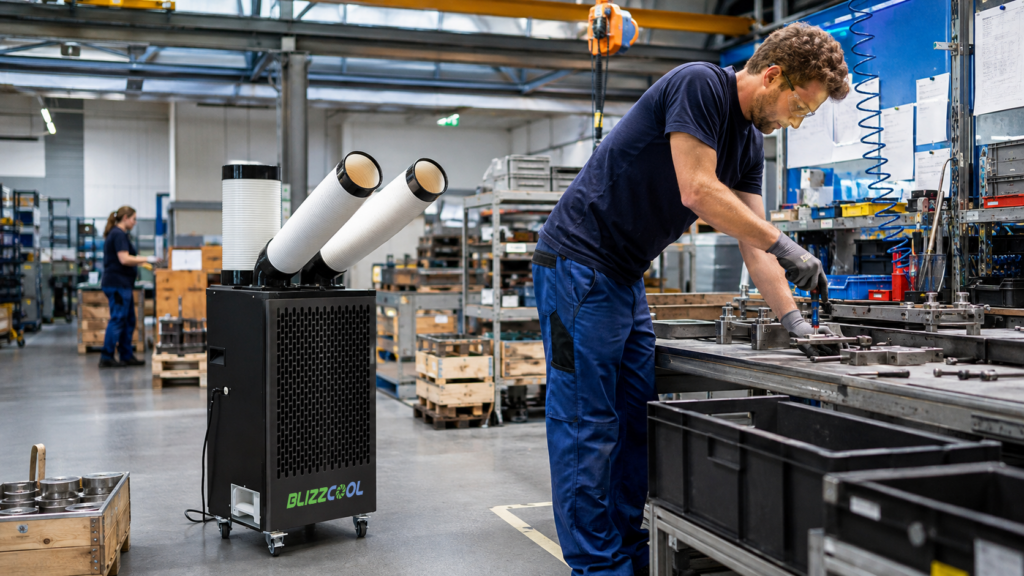
Before getting into the regulation, a practical note: meeting these ranges in a warehouse with machinery is rarely achieved by air-conditioning the entire space; the usual approach is to cool the workstation with a portable air conditioning unit for industrial use. We’ll develop this further below, after reviewing what each section of Annex III requires exactly.
What is RD 486/1997
Royal Decree 486/1997, of April 14, establishes the minimum safety and health provisions in the workplace. It is the regulation that develops the Occupational Risk Prevention Law regarding the physical space where work is performed: lighting, order, cleanliness, circulation routes and, in its Annex III, the environmental conditions of temperature, humidity, and ventilation.
Its underlying principle is clear: environmental conditions must not pose a risk to the safety and health of workers or be a source of discomfort. From there, it sets specific ranges for enclosed premises.
Temperature According to Annex III: The Exact Ranges
Annex III distinguishes the permitted temperature type according to the physical workload. The following table summarizes what the regulation specifies.
| Type of work | Temperature | Example |
|---|---|---|
| Sedentary work (office) | 17–27°C | Administrative tasks, seated customer service |
| Light work | 14–25°C | Light assembly, packaging, standing tasks |
| Moderate or heavy work | No numerical limit in the RD | Machining, welding, foundry, loading |
The decree itself clarifies that these limits apply to premises where sedentary or light work is performed, and that they are not enforceable in spaces where, due to the nature of the activity, it is impossible to maintain them. A foundry or a warehouse with furnaces will not be at 25°C, and the regulation acknowledges this: in those cases it refers to heat stress risk assessment.
Humidity and Ventilation: The Other Limits of Annex III
RD 486/1997 does not regulate only temperature. Annex III also sets two parameters that directly influence thermal sensation.
Relative humidity must be maintained between 30 and 70%, except in premises with risk of static electricity, where it must not fall below 50%. The minimum air renewal is set at 30 m³ of clean air per hour per worker for sedentary work in non-hot environments, and 50 m³ in other cases, to prevent stale air.
Regarding air velocity, the regulation sets limits to avoid annoying drafts: 0.25 m/s in non-hot environments, 0.5 m/s in hot sedentary work, and 0.75 m/s in hot non-sedentary work. There is a key nuance: these limits do not apply to air from ventilation or air-conditioning systems used to combat heat, where the limit becomes 0.25 m/s for sedentary work and 0.35 m/s for the rest. In other words, the regulation itself contemplates the use of air-conditioning to protect against heat.
Why There Is No Fixed Maximum Temperature in Industry
Because industrial work is almost never sedentary and because process heat makes a rigid limit unfeasible. In a warehouse with machinery, welding, or presses, the temperature is determined by the activity, not a thermostat. That is why, for moderate or heavy work, RD 486/1997 does not give a number: it requires the company to assess the risk of heat stress and adopt measures so that conditions do not harm health.
The National Institute for Safety and Health at Work (INSST) uses indices such as WBGT, which combines temperature, humidity, radiation, and physical effort, to assess whether a heat situation is dangerous. It is a more realistic measure than a single degree on the thermometer. The practical conclusion for a warehouse is that it is not enough to look at the ambient temperature: the whole situation must be assessed and action taken when the result exceeds safe thresholds.
Relationship with RD-ley 4/2023 on Extreme Heat
Royal Decree-law 4/2023 amended RD 486/1997 to strengthen protection against heat. Its main contribution is that, when the State Meteorological Agency issues an orange or red warning for high temperatures, the company must adapt working conditions, including reducing or rearranging the working day, if the risk cannot be controlled by other means. This obligation particularly affects outdoor work, but the principle of protecting against heat stress extends to any workplace.
It should not be confused with Royal Decree-law 14/2022, on energy saving, which set air-conditioning limits (27°C for cooling, 19°C for heating) for certain public and commercial buildings, but which did not modify the prevention thresholds of RD 486/1997 for workplaces.
What the Worker Can Demand and What the Company Risks
If the risk assessment detects a danger from heat or cold and the company does not correct it, it violates prevention regulations, which is punishable by the Labor Inspectorate. The worker can request that the thermal conditions of their workstation be assessed and that corrective measures be adopted. In situations of serious and imminent risk, the regulations support the interruption of activity.
For the company, keeping the workstation within a reasonable range is not just about avoiding penalties: heat above 26–28°C with physical effort reduces concentration, increases errors, and raises the risk of accidents, with a direct impact on productivity.
How to Comply with RD 486/1997 in a Warehouse or Workshop
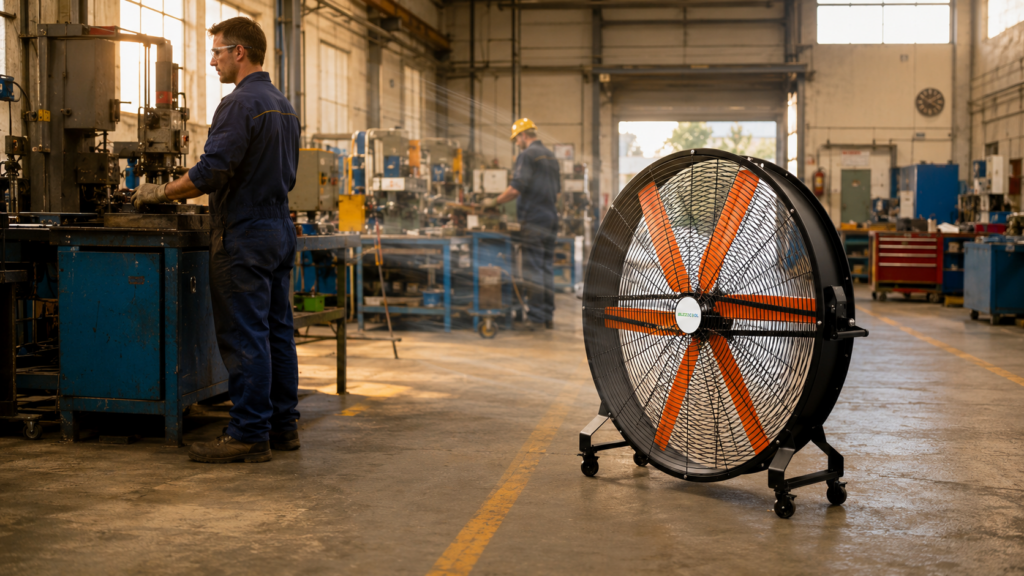
The realistic way to keep a warehouse within safe conditions is usually not to air-condition the entire volume, but to act on the workstations where heat affects people. Fully air-conditioning a warehouse with high ceilings, with doors that open and machinery that generates heat, is expensive and inefficient. When working with open doors, an evaporative cooler for large spaces can be more energy-efficient than a compressor unit. Combined with the organizational measures required by law (breaks, hydration, rotation), these solutions bring workstation conditions closer to the ranges of Annex III.
At Blizzcool, the industrial air-conditioning brand of INTEC Suministros Industriales, we advise on the real coverage of each unit before purchase: tell us the square meters, the activity, and the temperature you’re dealing with, and we’ll tell you which solution helps comply with the regulations while protecting your workers.