
There is no single maximum temperature set by law for working in factories. Royal Decree 486/1997 states that in enclosed workplaces with light work, the temperature must be between 14 and 25°C, and between 17 and 27°C for sedentary office work. For moderate or heavy work with machinery, which is common in a factory, the regulation does not set a specific number: it requires a risk assessment and that conditions do not harm the worker’s health.
That’s the short answer, and it surprises most companies looking for an exact limit. In this article you’ll see exactly what ranges the regulations set, why there’s no magic number in a facility with process heat, what the law requires you to do when safe temperatures are exceeded, and, above all, how to keep the factory temperature within a range that protects your operators without air-conditioning the entire building.
It’s worth making this clear from the start: temperature isn’t the only parameter regulated by law. The heat stress an operator experiences depends on temperature, but also on humidity, air speed, physical effort, and clothing. A workshop at 26°C with machinery and poor ventilation can be more dangerous than one at 28°C with good airflow.
What the law says: the ranges in Royal Decree 486/1997
Royal Decree 486/1997, on minimum health and safety requirements in workplaces, is the regulation that sets environmental conditions in enclosed spaces. It establishes two temperature ranges depending on the type of task.
| Type of work | Temperature under RD 486/1997 | Example |
|---|---|---|
| Sedentary work (office) | 17–27°C | Administration, seated quality control |
| Light work | 14–25°C | Light assembly, packing, standing manual tasks |
| Moderate or heavy work | No numeric limit set | Machining, welding, foundry work, physical load |
Most factory work falls into the light-work category (14–25°C) or directly into intense physical work, for which the Royal Decree does not provide a number. Here’s the nuance almost nobody explains: those ranges are intended for workplaces, and the RD itself clarifies that they do not apply to areas where, due to the activity, it is not possible to maintain them. A foundry or a plant with furnaces is never going to be at 25°C, and the law assumes that.
Why isn’t there a fixed maximum temperature in a factory?
Because industrial work is rarely sedentary and because process heat makes it impossible to apply a rigid cap. In a facility with machinery, furnaces, welding, or presses, the temperature is set by the activity itself, not a thermostat. That’s why the regulation changes approach: instead of imposing a number, it requires the company to assess the risk of heat stress and adopt measures so conditions do not harm health.
The National Institute for Safety and Health at Work (INSST) uses indices such as WBGT (wet bulb globe temperature) to assess whether a heat situation is dangerous, combining temperature, humidity, radiation, and effort. It’s a more accurate way to measure real risk than a simple thermometer reading. The practical conclusion for a factory is clear: it’s not enough to look at ambient temperature—you have to assess the whole picture and act if the result exceeds safe thresholds.
Humidity and air currents: the other two limits set by the regulations
In addition to temperature, RD 486/1997 regulates relative humidity and air speed, two factors that directly affect how hot it feels. Relative humidity must be kept between 30% and 70% (or not drop below 50% where there is a risk of static electricity).
As for air currents, the regulation sets maximum speeds to avoid discomfort: 0.25 m/s in non-hot environments, 0.5 m/s for sedentary work in hot environments, and 0.75 m/s for non-sedentary work. There’s an important detail for factories: these limits do not apply to air generated by fans or air conditioning used specifically to combat heat, where the cap becomes 0.25 m/s for sedentary work and 0.35 m/s for the rest. In other words, the law anticipates and allows the use of air conditioning and forced ventilation to protect workers from heat.
What the company must do when safe temperatures are exceeded
Since 2023, Royal Decree-Law 4/2023 has strengthened employers’ obligations in the face of extreme heat. When AEMET issues an orange or red warning for high temperatures and the risk cannot be controlled with other measures, the company must adapt or reduce the working day, and may even have to stop tasks that pose a danger to the worker.
This obligation mainly applies to outdoor work, but the underlying principle applies to any workplace: if the risk assessment detects heat danger and the company does not correct it, it is in breach of the Occupational Risk Prevention Law, which is punishable. Required measures range from reorganizing schedules and breaks to ensuring cool water, breathable clothing, and, when heat is structural, technical means to lower the temperature at the workstation. The regulations don’t just warn about the risk—they require action.
What happens above certain temperatures: risks to health and production
Above 26–28°C with physical effort, performance and safety begin to drop in measurable ways. The body works to maintain its internal 37°C and, when it can’t, fatigue, loss of concentration, cramps, and, at the extreme, heatstroke can appear— a medical emergency that occurs when body temperature exceeds 40°C.
For the company, this has two sides. On the one hand, the operator’s health and legal responsibility. On the other, productivity: an overheated worker makes more mistakes, performs worse after half a shift, and increases the risk of accidents with machinery. In a machining or welding workshop, keeping the workstation within a reasonable range isn’t just about complying with the law—it’s about protecting production.
How to keep the factory within safe temperatures
The realistic way to control temperature in a factory is usually not to air-condition the entire building, but to cool the workstations where heat affects people. Fully air-conditioning a high-ceiling facility with doors opening and machinery generating heat is expensive and inefficient, and often not feasible.
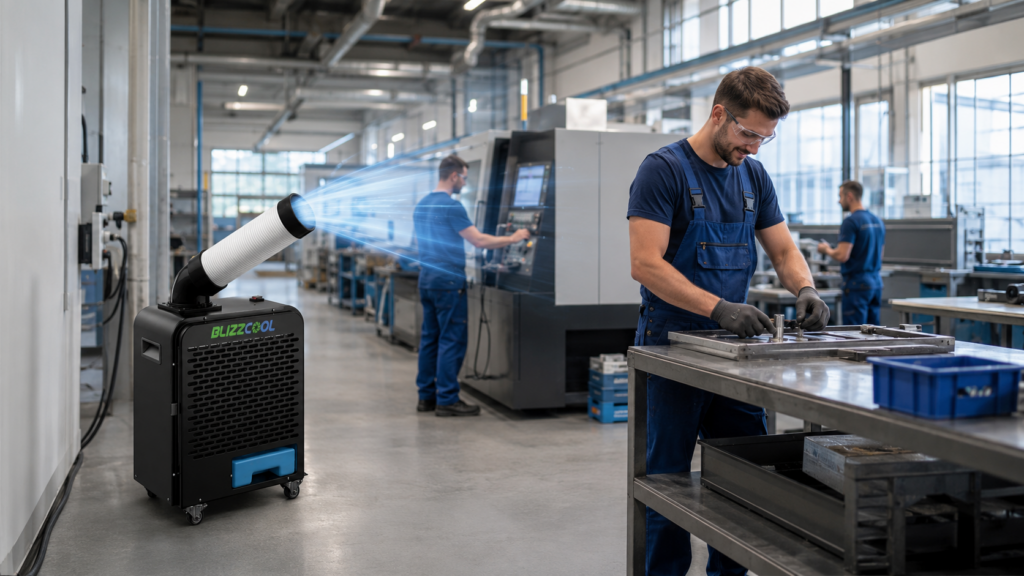
The alternative more and more workshops are using is to direct cooling to the operator. A portable industrial air conditioner cools the workstation without construction or installation, works in environments up to 45°C, and solves the critical point (the person) without the cost of cooling thousands of cubic meters. Depending on the type of facility, an evaporative cooler or high-volume fans can be even more energy-efficient. Combined with the organizational measures required by law (breaks, hydration, rotation), these solutions help keep conditions within a safe range.
Cool the workstation and comply with the regulations
Complying with working temperature requirements in a factory doesn’t require a huge investment in fixed air conditioning. In most workshops and facilities, what you need to control are the workstations where heat affects operators and production—not the empty cubic meters under the roof. Choosing the right solution depends on whether the facility operates with doors open or closed, humidity, and ceiling height—something we explain in detail in this guide on how to cool an industrial facility, comparing the most common options.
At Blizzcool, INTEC Suministros Industriales’ industrial climate control brand, we advise you on the real coverage of each unit before you buy: tell us the square meters, the activity, and the temperature you’re dealing with, and we’ll tell you which solution keeps your factory within safe temperatures and protects your operators’ performance. We offer units that plug into a socket and cool the same day, with our own warranty and after-sales service.