
An industrial air conditioner is a climate control system designed to regulate temperature, humidity, and air quality in demanding work environments: machining workshops, production facilities, warehouses, data centers, or event venues. Unlike residential units, they are built to operate continuously, withstand dust, vibrations, and high thermal loads, and cool spaces ranging from a few square meters to thousands.
What distinguishes an industrial unit from a residential one is not just power: it’s the ability to work non-stop under adverse conditions and manage heat loads that a home split system couldn’t absorb. In this article you’ll see what types exist, what differences there are between them, and above all, which one fits your installation size and what you actually need to cool.
Key differences between industrial and residential air conditioning
The most visible difference is cooling capacity. A typical residential unit offers between 2,000 and 5,000 frigories/hour; an industrial air conditioner can start from those same figures in compact models and reach several hundred thousand in centralized installations. But capacity is just one of the factors:
- Continuous use: industrial units are designed to run 8, 12, or 24 hours straight without degrading performance. Residential units are not designed for that.
- Robustness: steel casings, components sealed against dust and moisture, and electrical protections you won’t find in a residential split.
- Temperature and humidity control: many industrial systems allow precise adjustment of relative humidity, something critical in sectors like food, pharmaceuticals, or printing.
- Maintenance: easy access to filters, compressors, and components, because in a production facility a breakdown can’t wait a week.
Types of industrial air conditioning: from entire facility to workstation
Here’s the distinction that most confuses those looking for a solution for their business: not all industrial air conditioners require construction work, complex installation, or an investment of tens of thousands of euros. There are two main categories:
Centralized systems (for entire facilities)
These are the units most people associate with “industrial air conditioning”: chillers (water coolers), VRF/VRV systems, and rooftop units. They are installed to cool entire buildings and require ductwork, specialized electrical installation, maintenance by certified companies, and an investment that rarely drops below €10,000-15,000 for small installations. They are the solution when you need to control the climate of an entire plant or industrial office building.
Portable spot coolers (for specific workstations)
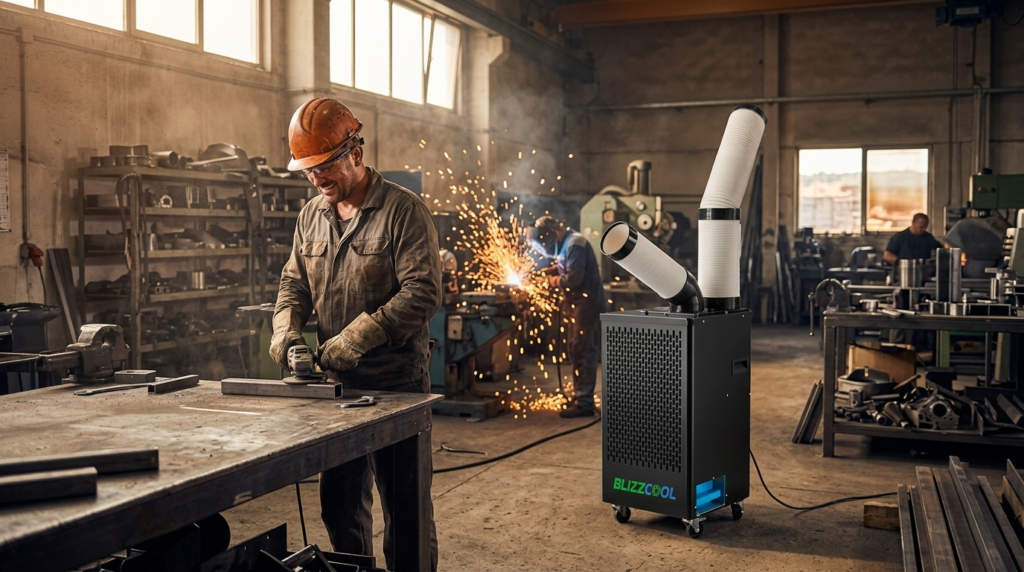
This is the option many businesses don’t know about or don’t consider, and it’s often the most practical for medium-sized workshops and small facilities: portable industrial air conditioners or spot coolers are self-contained wheeled units that cool directly at the workstation where the operator is, without construction work, without permanent installation, and ready to operate in minutes. A unit of this type can offer between 2,500 and 5,300 frigories/hour, cooling the immediate work area of one or two operators in fixed positions.
The practical difference is significant: in a welding workshop with five operators, you don’t need to cool the entire 800 m² facility, just the five stations where heat affects performance. One spot cooler per station is cheaper, faster to deploy, and consumes less than installing a centralized system for the entire space.
Which sectors most commonly use industrial air conditioning
Environments where heat directly affects productivity or safety are the most common:
- Machining, welding, and die-making workshops: machines and processes generate constant heat. Operators exposed to more than 28-30°C progressively lose concentration and performance, a problem well documented in industrial ergonomics studies.
- Production and logistics facilities: intense physical work and heat processes require thermal control to comply with workplace welfare regulations.
- Events and temporary venues: spot coolers are the only option when permanent installation is not possible.
- Electrical rooms and control rooms: sensitive electronics need strict temperature ranges to operate without failures.
How to choose the right unit for your business
The right question is not “how many square meters do I have?” but “what exactly do I need to cool?” Answering that determines whether you need a centralized system or a set of portable units.
If the goal is to protect the health and performance of operators at fixed stations within a facility, the technical data to consider are cooling capacity (frigories/hour or BTU), airflow (m³/hour), and air stream reach. A 5,300 frigories/hour unit with an airflow of 900 m³/hour can effectively cool a work area with a 4-6 meter radius. For an ambient temperature of 38°C in summer, it’s reasonable to have one unit for every two workstations that need direct cooling.
You also need to consider whether the space has ventilation: the spot cooler works by evacuating heat outside through a duct. Without an evacuation point or exterior outlet, the heat doesn’t leave the facility and the unit cannot cool effectively.
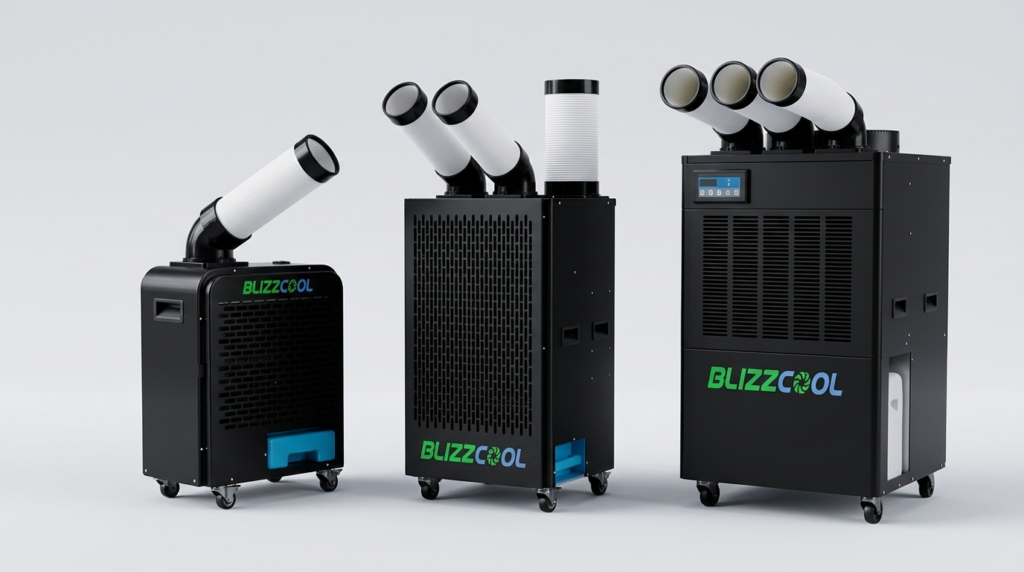
Blizzcool: industrial spot coolers without installation or construction work
Blizzcool specializes in portable industrial air conditioners designed to solve exactly this problem: operators suffering from heat at specific workstations, without needing to cool the entire facility. Their Spot Cooler range reaches 5,300 frigories/hour, includes wheels for moving within the facility, and operates without construction work or special electrical installation, just plugging into the mains.
For businesses looking for an immediate solution (arrives today, works today) at a reasonable cost compared to installing a centralized system, it’s the most direct alternative in the Spanish market. Blizzcool’s Renewal Plan also allows replacing old units with a discount, reducing the cost of upgrading a workshop’s climate control without starting from scratch.