
If this summer you’re looking for an efficient alternative to air conditioning for your industrial facility, workshop, or workspace, you’ve probably heard of evaporative cooling. In this article, we explain what it is, how it works, and why more and more companies in Spain are opting for this system. And if you already know it’s what you need, you can buy an evaporative cooler directly from our store.
What is an evaporative cooler?
An evaporative cooler is a climate control unit that reduces air temperature by leveraging the natural process of water evaporation. Unlike conventional air conditioning, it doesn’t use compressors or refrigerant gases: its only “fuel” is water.
The operating principle is the same one used for centuries by the ‘botijo’ (earthenware jug): when water evaporates, it absorbs heat from the surroundings and cools them. Evaporative coolers apply this phenomenon in a controlled and efficient way to cool large volumes of air with very low energy consumption.
How does an evaporative cooler work?
The operation of an evaporative cooler always follows the same process:
- Outdoor air intake. A powerful fan draws in hot ambient air.
- Passage through wet pads. The air passes through cellulose or fiber pads soaked in water. Upon contact, the water evaporates and absorbs heat from the air.
- Cold air discharge. The resulting air, 6 to 15 °C cooler than the outside air, is distributed throughout the space to be cooled.
- Continuous air exchange. Unlike air conditioning, an evaporative cooler always works with fresh outdoor air, constantly renewing the environment instead of recirculating it.
For the system to work correctly, it’s important that the space has air outlets: doors, windows, or extractors that allow hot air to escape as cold air enters. This is especially easy to achieve in industrial facilities, workshops, and warehouses.
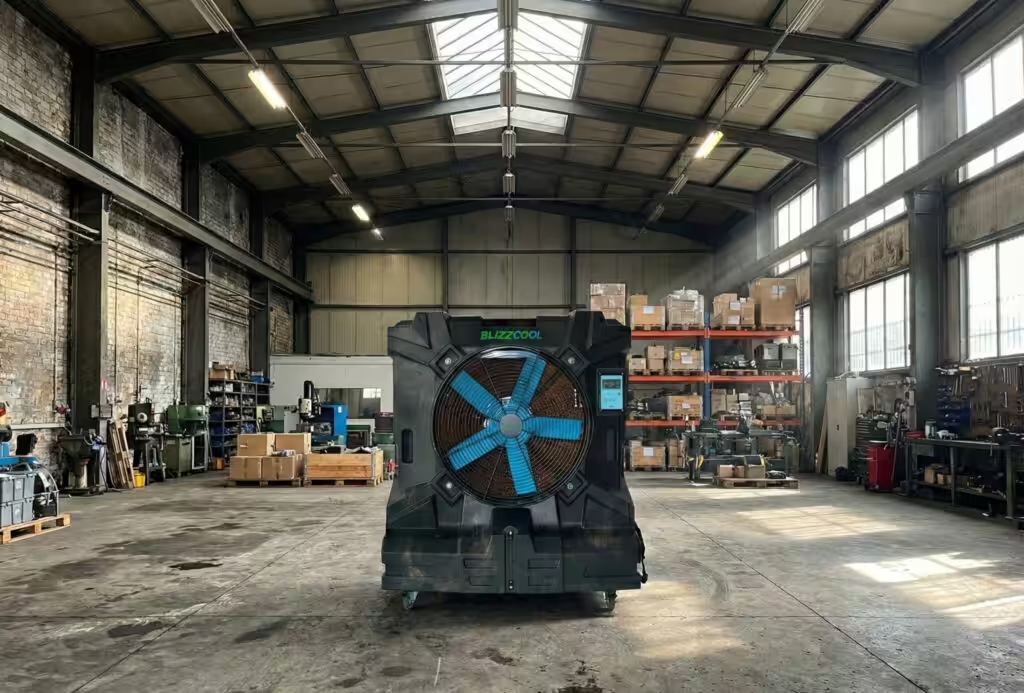
Types of Evaporative Coolers
Not all evaporative cooling units are the same. There are three main categories based on their cooling system and format:
Direct evaporative cooling. This is the most common system. Air passes directly through wet pads, which cools and humidifies the environment simultaneously. It is most efficient in dry and hot climates, such as those in inland Spain.
Indirect evaporative cooling. Air is cooled through a heat exchanger without direct contact with water, so it does not increase ambient humidity. It is more suitable for areas with high humidity.
Portable evaporative cooler. This is the compact version with no fixed installation. A portable evaporative cooler can be easily moved from one space to another, making it a very flexible solution for businesses with occasional or seasonal cooling needs. Industrial portable models, like Blizzcool’s, are designed to cover hundreds of square meters with full mobility.
Advantages of evaporative cooling
The growing popularity of evaporative coolers in the industrial sector is no coincidence. These are their main advantages over other systems:
- Real energy savings. An evaporative cooler consumes between 70 and 80% less electricity than an air conditioning unit of equivalent power. While an industrial split unit can consume between 8 and 15 kW/h, an industrial evaporative cooler of similar capacity consumes between 0.5 and 3 kW/h.
- No complex installation. Portable models require no construction, piping, or licenses. They plug in and work.
- 100% fresh and healthy air. By always working with outdoor air, they eliminate stale air and improve air quality in workspaces.
- Zero polluting gases. They do not use refrigerant fluids, so they do not contribute to the greenhouse effect or are subject to F-Gas regulations.
- Simple and economical maintenance. Without a compressor or gas, maintenance is limited to periodic cleaning of the pads and water tank.
- Operation in open spaces. Unlike air conditioning, which requires enclosed spaces to be effective, an evaporative cooler works perfectly in facilities with open doors, loading areas, or semi-open spaces.
Limitations you should know about
To make an informed decision, it’s also important to be aware of the limitations of this system:
Depends on ambient humidity. Evaporative coolers are most effective in dry climates. In areas with relative humidity above 70%, their cooling capacity is significantly reduced. For most of inland Spain —Castilla, Aragón, Extremadura, Murcia, Alicante— they are an excellent solution. In very humid coastal areas, a preliminary study is advisable.
They need ventilation. The space must have air outlets for the system to work correctly. It is not the right solution for completely hermetic spaces.
They do not allow exact temperature control. Unlike air conditioning, it is not possible to set a precise temperature: cooling depends on current outdoor conditions.
What spaces are evaporative coolers suitable for?
Evaporative cooling is especially designed for large spaces where conventional air conditioning is not viable or too expensive to install and operate:
- Industrial and production facilities
- Mechanical, body, and paint workshops
- Warehouses and logistics centers
- Sports halls and gyms
- Industrial kitchens and catering facilities
- Outdoor events and marquees
- Restaurant terraces
- Greenhouses and livestock farms
Evaporative cooler vs. air conditioning: which to choose?
This is the question most industrial facility managers ask themselves before investing. The answer depends on the type of space and its use:
| Evaporative Cooler | Air Conditioning | |
|---|---|---|
| Energy Consumption | Very Low (0.5 – 3 kW/h) | High (8 – 15 kW/h) |
| Installation | Simple or no installation | Complex, requires construction |
| Open Spaces | ✅ Ideal | ❌ Does not work well |
| Temperature Control | Approximate | Precise |
| Refrigerant Gases | No | Yes |
| Maintenance Cost | Low | Medium-High |
| Ambient Humidity | Slightly increases it | Reduces it |
In summary: if you have a large industrial space with natural ventilation and in a dry or temperate climate zone, an evaporative cooler is by far the most cost-effective option. If you need precise temperature control in a closed, hermetic space, air conditioning may be more suitable.
How much can an evaporative cooler lower the temperature?
Under optimal conditions, an evaporative cooler can reduce the temperature by 6 to 15 °C compared to the outdoor environment. In very dry climates like inland Spain, drops can exceed 12 °C. Although the Mediterranean coast has higher humidity than the interior, industrial areas of Valencia, Alicante, or Murcia benefit greatly from this system during the summer months, especially during the central hours of the day.
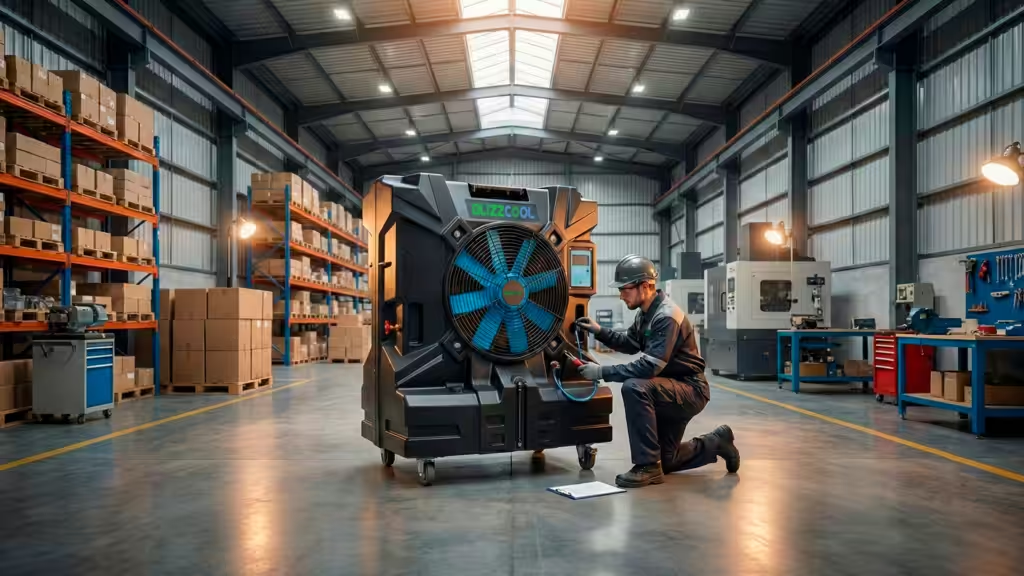
Is a portable evaporative cooler suitable for an industrial facility?
Yes. Portable industrial models are designed to cover areas from 200 to over 1,000 m², with very high airflow rates. Their great advantage is that they can be moved wherever they are most needed at any given moment, without the need for construction or fixed installation.
Blizzcool: industrial evaporative coolers for demanding environments
Now that you know exactly what evaporative cooling is and how it works, if you are looking for quality equipment for your company or facility, at Blizzcool you will find a range of industrial evaporative coolers designed and tested in real environments. You can view all our models and buy an evaporative cooler directly from our online store. If you have questions about which equipment best suits your space, our team will advise you without obligation.