
Cooling an industrial facility doesn’t have a single answer. The most efficient solution for a logistics warehouse with open doors and constant merchandise traffic is not the same as for a factory with processes that generate intense heat and sealed windows. Knowing the available options, their real limitations, and the criteria that determine when each applies is what makes the difference between a sound investment and underutilized equipment.
In this article, you’ll find an objective comparison of the five most commonly used solutions for industrial facility climate control, with the technical data that matters and the selection criteria most guides don’t mention. If your facility has high ceilings and continuous activity, industrial ceiling fans are probably the most efficient starting point, but it’s worth understanding why before deciding.
Why Conventional Air Conditioning Doesn’t Work in Most Industrial Facilities
The first instinct of many installation managers when heat becomes a problem is to think of climate control systems like air conditioning. It’s understandable: it’s the known solution for offices and commercial premises. The problem is that conventional air conditioning requires an enclosed space to recirculate air and maintain temperature. As soon as a door is open, that efficiency plummets.
Most industrial facilities operate with open doors for a good part of the day: incoming and outgoing merchandise, vehicles in transit, ventilation needs for production processes. Under these conditions, conventional climate control equipment consumes between 5 and 15 kW to cool a space that never truly closes. The daily cost makes the investment unprofitable in most cases.
The Five Real Options for Cooling an Industrial Facility
Natural Ventilation
The zero-cost option. If the facility has doors or windows on opposite sides and sufficient external wind, cross-ventilation can lower the temperature by several degrees without any equipment. It’s useful as a complement but rarely sufficient on its own during the hottest months, especially in unfavorably oriented facilities or areas with scarce winds.
Industrial Ceiling Fans
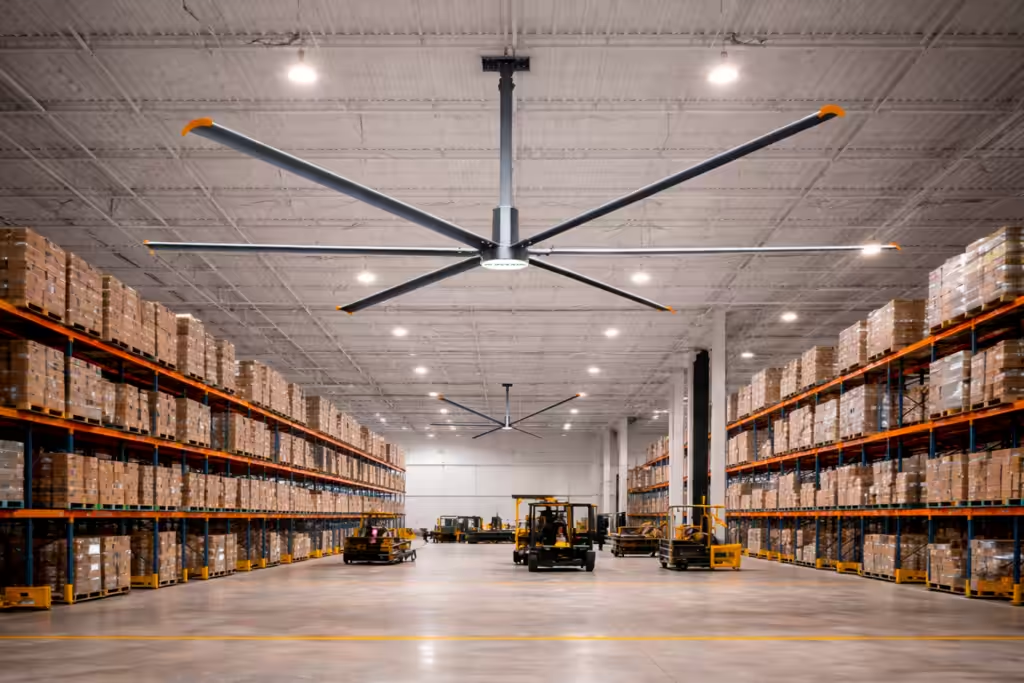
HVLS (High Volume, Low Speed) fans are large ceiling fans with blades between 2.4 and 6 meters in diameter that rotate at low speed, moving enormous volumes of air. They don’t cool the air, but they generate a constant and uniform breeze that reduces the perceived temperature by 4 to 6 °C, break up hot air stratification, and substantially improve worker comfort.
Their consumption is remarkably low: an HVLS fan with a 6-meter diameter does not exceed 1.5-2 kW, covering areas up to 1,800 m² with a single unit. For a 1,000 m² facility, that’s less than 2 euros per day in electricity consumption when operating 10 hours. They are especially effective in facilities with open doors, where evaporative systems and air conditioning lose efficiency.
Industrial Wall and Portable Fans
Industrial wall fans and high-volume portable models complement HVLS fans well in spaces where direct ventilation is needed over specific work areas. They don’t cover as large areas as an HVLS, but they allow air flow to be precisely directed towards points of higher thermal load: production lines, welding areas, individual workstations. Their installation is quick and requires no construction work.
Evaporative Coolers
Evaporative coolers pass air through moistened pads, reducing air temperature by 8 to 11 °C through evaporation. They are more effective than fans in dry, hot climates, and their energy consumption is up to 80% lower than that of an equivalent air conditioning unit.
Their main limitation is that they need hot air to be able to exit the facility to be effective: if the space is closed or poorly ventilated, humidity accumulates and efficiency drops. They work well in facilities with natural ventilation or extractors, but they are not the right solution in areas with high relative ambient humidity or in processes that do not tolerate increases in humidity.
Misting Systems
Misting systems spray finely atomized water particles that evaporate before touching surfaces, creating a localized cooling effect. They are effective outdoors or in semi-open spaces such as industrial terraces or loading/unloading areas. Indoors, their use is more limited, as humidity accumulation can be a problem in sensitive industrial processes or environments with machinery that does not tolerate humidity.
The Most Influential Criterion: Open or Closed Facility?
Before evaluating power, price, or brand, there’s one question that filters most decisions: does the facility operate with open or closed doors during the workday?
If it operates with open doors, whether due to logistical needs, production processes, or required ventilation, systems that depend on an enclosed space (conventional air conditioning, evaporative coolers without adequate extraction) will perform below their potential. In that scenario, HVLS industrial ceiling fans are the most efficient solution: they work precisely under these conditions, do not depend on the space being closed, and maintain their performance regardless of door traffic.
If the facility operates closed, with access control and without constant merchandise traffic, evaporative coolers or industrial air conditioning may be more suitable options, provided that ambient humidity and processes allow it.
What Regulations Say About Workplace Temperature
Royal Decree 486/1997 on workplaces establishes that in areas where sedentary work is performed, the temperature must be between 17 and 27 °C, and for light work, between 14 and 25 °C. For intense physical activity, the limits are stricter. Exceeding these ranges is not just a comfort problem: it implies a risk of thermal stress, decreased performance, and legal responsibility for the company.
A study cited by NASA shows that above 25 °C, each additional degree of temperature reduces work performance by 2%. In a facility with 30 workers at 35 °C during the summer months, the impact on productivity and accident rates alone justifies the investment in an effective ventilation system.
There’s also a solution for winter
One of the least mentioned arguments when evaluating HVLS ceiling fans is their performance in colder months. In facilities with high ceilings, heat generated by machinery, worker activity, or heating rises and accumulates under the roof. In spaces 8 meters or more in height, the temperature difference between the floor and the ceiling can exceed 10 °C.
By reversing the fan’s rotation, the accumulated warm air gently and uniformly descends without creating an uncomfortable draft on workers. The result is a reduction in heating consumption, which in real installations is between 20 and 30%. Equipment that reduces heat in summer and heating consumption in winter amortizes its cost in a way that no evaporative cooler or air conditioner can match.
Reducing Heat in Your Facility is a One-Time Decision
Most companies that install an industrial ventilation system do so after a difficult summer, when the impact on productivity is already visible and pressure on the team is at its peak. Getting ahead of that point allows for a calm decision-making process, comparing options judiciously, and choosing the system that best fits the type of facility, activity, and available budget.
If, after reading this guide, you are clear that your facility needs high-performance ceiling ventilation, at Blizzcool you will find a range of industrial ceiling fans with diameters from 2,400 to 6,100 mm. Our technical team can calculate which model covers your space with the lowest possible consumption and advise you on whether HVLS fans are the optimal solution for your installation or if they should be combined with another system.