
To choose a ceiling fan properly, you first need to answer a question that almost no guide asks: what space is it for, and how will it be used? Blade diameter, motor type, and the airflow you need vary hugely depending on whether you’re ventilating a 12 m² bedroom or an 800 m² warehouse. In this article you’ll find the real criteria that determine whether a specific model will solve your problem or not, including the question many installation managers ask too late: when a domestic fan isn’t enough and when you need to choose an industrial ceiling fan.
Room size is your starting point
Blade diameter is the first filter. The relationship between the area to be ventilated and the fan size determines whether the unit can move the required air volume or whether it will always be running at its limit, with more noise and lower performance than expected.
The usual reference for home use is this: up to 12 m², a fan between 90 and 110 cm in diameter is enough; between 12 and 20 m², you need 110 to 130 cm; for rooms of more than 20 m², it’s best to start at 132 cm. The logic is simple: a large fan spinning slowly moves more air, makes less noise, and uses less power than a small one forced to spin fast.
From 50–60 m² onwards, the scale changes completely. In that range, conventional domestic fans stop being the right solution regardless of their diameter, because they aren’t designed to move the volume of air that space requires.
The fan’s airflow is the spec few guides mention
Home buying guides talk about diameter in centimetres and power in watts. They rarely mention airflow in m³/h, which is the parameter that truly defines a unit’s ventilation capacity.
Airflow indicates how many cubic metres of air the fan moves each hour. For a bedroom with a volume of 30 m³ and 10 air changes per hour, you need 300 m³/h: any mid-range domestic fan covers that with room to spare. For a warehouse with a volume of 3,500 m³ and 40 air changes per hour, you need 140,000 m³/h—an airflow that only industrial HVLS fans can achieve with a single unit and reasonable power consumption.
When the manufacturer doesn’t list airflow in the technical sheet for a fan sold as “industrial” or “for large spaces”, that already tells you something about the type of unit you’re considering.
When a domestic ceiling fan is enough
A domestic ceiling fan works well for ventilation in homes, small offices, or premises under 40–50 m² with standard ceiling heights (between 2.4 and 3 m). If it’s occasional use, the space is moderate, and you don’t need continuous operation for hours, any quality domestic model with the right diameter will do the job well.
In this context, the criteria that make the biggest difference are noise level (essential in bedrooms), the reverse function to make use of heat in winter, the type of control (pull chain, remote control, or WiFi), and compatibility with the existing electrical installation.
When you need an industrial ceiling fan
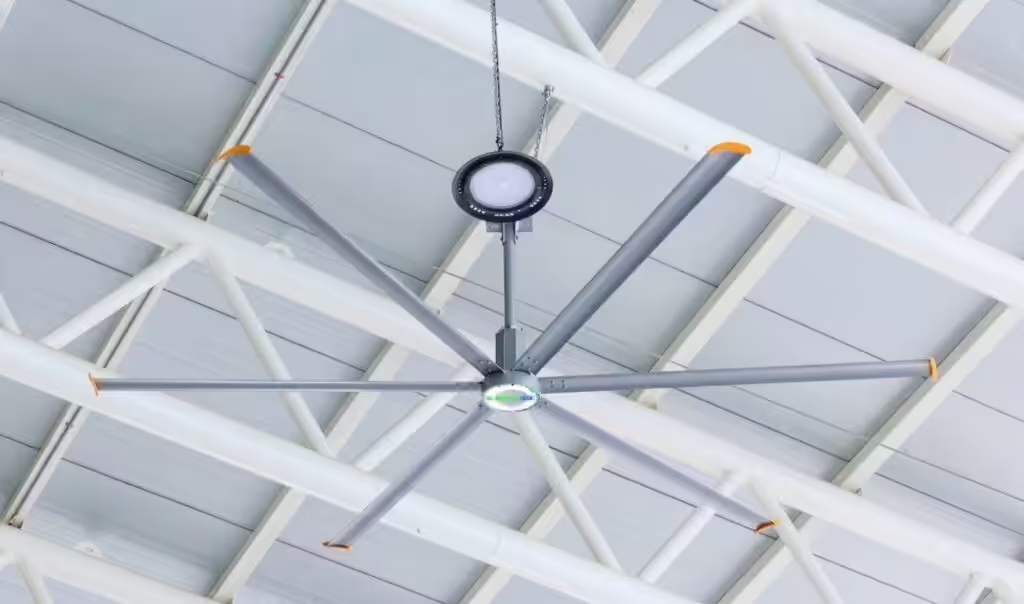
Moving up to an industrial ceiling fan is necessary when one or more of these conditions apply: the space exceeds 200–300 m², the ceiling is higher than 4–5 m, the fan will run continuously during work shifts, or heat generated by machinery or intense activity makes conventional ventilation insufficient.
In these cases, HVLS (High Volume, Low Speed) fans are the go-to solution. Their large-diameter blades—over 6 m on the biggest models—spin at low speed, moving huge columns of air quietly and evenly. A single unit can cover areas of up to 1,800 m² with power consumption that doesn’t exceed 1.5–2 kW—an efficiency ratio that’s impossible to achieve by using multiple domestic fans.
Another key factor is winter operation. In warehouses with high ceilings, heat generated by machinery or heating rises and accumulates under the roof, and there can be differences of 8 to 12°C between the floor and the ceiling. By reversing the HVLS fan’s rotation, that warm air is gently pushed down without creating a draft, reducing heating consumption by 20–30%.
Ceiling height and installation type
Ceiling height affects both the model and the installation method. For home ceilings up to 2.7 m, the fan is installed directly to the ceiling or with a short downrod to maintain the minimum safety clearance of 2.1 m between the blades and the floor. For high or sloped ceilings, you need an extension downrod or the fan must allow for angling.
In industrial settings, the ceiling is often 5, 8, or even 12 m high. At those heights, a domestic fan not only won’t deliver enough airflow to the floor, but the installation itself requires mounting systems and structural support that domestic units don’t account for. Industrial HVLS fans are designed specifically for these height ranges, with certified anchoring systems for use in warehouses and steel structures.

What else should you consider before choosing your ceiling fan?
Beyond size, motor, and airflow, there are three aspects worth checking before you finalise your purchase.
First is the real operating noise level. Manufacturers state the motor noise level, but total noise also depends on rotation speed and blade design. A large-diameter fan spinning slowly will always be quieter than a small one at high speed with the same final airflow.
Second is the duty cycle the motor is rated for. If the fan will be on for full workdays, this isn’t optional: a domestic motor forced to run 10 hours a day will wear out sooner than expected and can create safety issues.
Third is after-sales service and spare parts availability. In industrial installations, downtime of a ventilation unit has a real operating cost. Choosing a specialist manufacturer with technical support and available spare parts isn’t an extra—it’s part of the total cost of the installation.
If your space needs industrial ceiling ventilation
If, after reading this guide, you’ve identified that your space is beyond what a domestic fan can handle, the next step is to assess which HVLS model fits your installation. The required airflow, ceiling height, and area to be covered determine the optimal diameter, and that combination varies enough between sites that it’s worth getting advice before you buy.
At Blizzcool you’ll find a range of industrial ceiling fans with diameters from 2,400 to 6,100 mm, designed for logistics warehouses, storage facilities, workshops, and sports halls. Our technical team can help you calculate which model covers your space with maximum efficiency and the lowest possible consumption.