
The cost of climate controlling an industrial warehouse depends on three variables that should be considered separately before requesting any quote: the equipment installation or acquisition cost, the daily operating cost in electricity consumption, and the annual maintenance cost. A system that is cheap to install can be expensive to run, and vice versa. Without this distinction, comparing options is practically impossible.
In this article, you’ll find real figures organized by system, a total cost comparison for a typical warehouse, and the criteria that determine which option offers the lowest cost per square meter based on the type of installation. If your warehouse has high ceilings and continuous activity, ceiling fans for industrial warehouses and factories are usually the option with the best cost-performance ratio, but the data speaks for itself.
Why the Final Price Isn’t Just the Installation Cost
This is the most common mistake when comparing industrial climate control systems: focusing only on the installation budget and not calculating what it will cost to keep that system running for the next 10 years.
An industrial air conditioning unit can have an installation cost of 15,000-40,000 euros in a medium-sized warehouse, but it also consumes between 8 and 15 kW per hour of operation. At an average of €0.18/kWh in Spain, that’s between €1.44 and €2.70 per hour. In a warehouse operating 8 hours a day for 5 hot months, the annual operating cost in electricity alone can exceed 2,500-5,000 euros, not counting the mandatory maintenance of refrigerant gas equipment.
The 5-year total cost of ownership is the data that truly matters, and it’s what no installation quote includes by default.
How Much It Costs to Climate Control an Industrial Warehouse with Each System
Warehouse with Ducted Industrial Air Conditioning
This system has the highest initial investment and highest operating cost. For a 500-1,000 m² warehouse with a standard ceiling, a ducted installation with sufficient capacity can range from 15,000 to 50,000 euros depending on complexity, required power, and whether pre-installation exists. To this, you must add the mandatory annual maintenance of refrigerant gas circuits, which usually costs around 500-1,500 euros per year.
Its main advantage is precise temperature control in fully enclosed spaces. Its most significant limitation in industrial environments is that it needs doors and windows closed to operate efficiently: as soon as there is merchandise traffic or frequent opening of access points, performance drops and consumption skyrockets.
Warehouse with Evaporative Coolers
Evaporative coolers have a lower acquisition and installation cost than air conditioning: depending on the model and the area to be covered, a fixed industrial unit can range from 3,000 to 10,000 euros installed. Large-capacity portable models can be purchased from 2,000-4,000 euros without installation.
Their electricity consumption is significantly lower than air conditioning: a unit covering 250-600 m² consumes between 1 and 2 kWh, which is equivalent to 0.18-0.36 euros per hour of operation. Maintenance is simple and economical: filter cleaning and water pump inspection, with no gas circuits or mandatory certified technicians.
Their limitation is their dependence on ambient humidity: on very humid days, their effectiveness decreases, and they need hot air to be able to exit the warehouse to function correctly.
Industrial Warehouse with Ceiling Fans
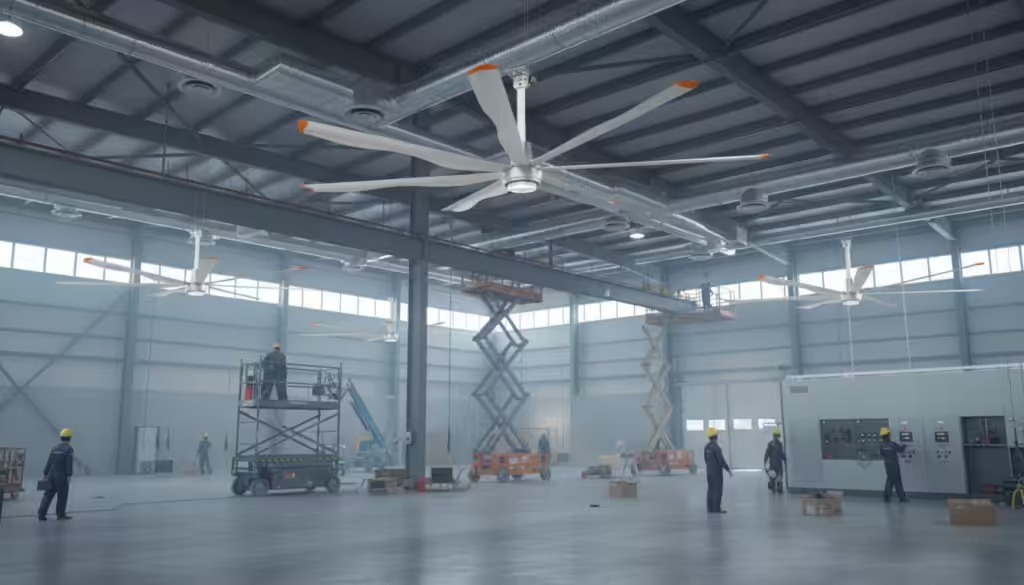
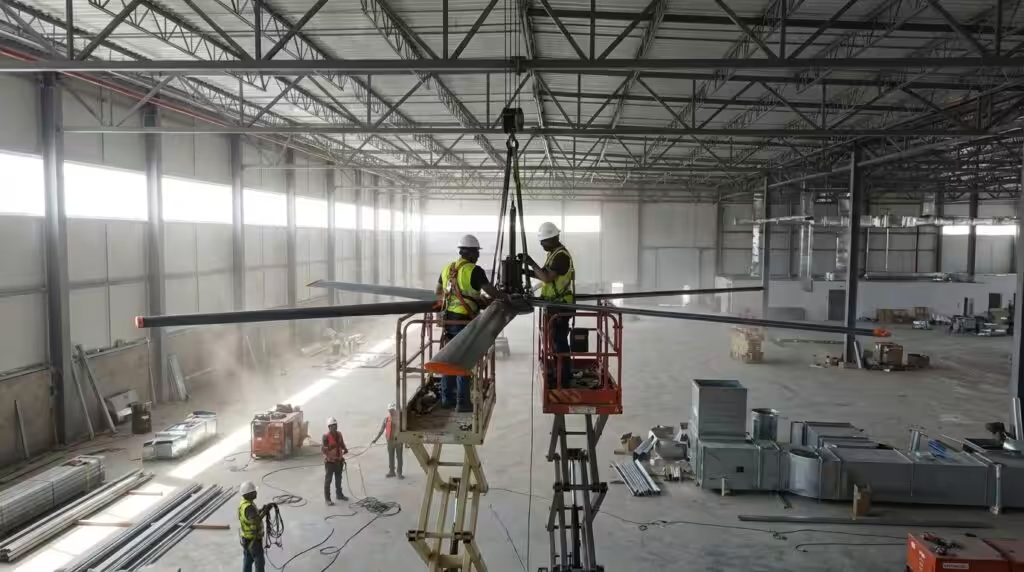
HVLS fans represent the option with the lowest operating cost among all types of industrial ventilation. Their initial investment is moderate: professional-grade models for industrial warehouses, such as those in Blizzcool’s Bizzcool range, start from 1,300 euros at public prices, with installation that requires no construction work or structural modifications.
Their electricity consumption is the lowest of all systems: a large-diameter HVLS fan does not exceed 1.5-2 kW per hour, which is equivalent to 0.27-0.36 euros per hour at full load. Covering up to 1,800 m² with a single unit, the cost per ventilated square meter is unbeatable. Maintenance is minimal: annual inspection of the suspension system and blade cleaning, with no consumables or specialized technicians.
They don’t cool the air, but they reduce the perceived temperature by 4 to 6 °C by generating a constant breeze and breaking heat stratification. In warehouses with open doors, where other systems lose efficiency, they maintain their performance regardless of traffic.
Warehouse with Wall-Mounted and Portable Fans
These are the option with the lowest initial investment. A high-performance industrial wall-mounted fan like Blizzcool’s BP1200 is in the mid-to-high range of the professional market with an airflow of 26,000 m³/h, far exceeding hardware store models. Large-diameter portable models like the GD120 have an accessible acquisition price with no installation cost.
Their consumption is low (60-300 W depending on the model) and they do not require specialized maintenance. They are the most flexible solution for medium spaces or to complement other systems in specific work areas.
Cost Comparison: Installation, Operation, and Maintenance
The following table shows an indicative estimate for a 1,000 m² warehouse operating 8 hours a day for 5 months a year:
| System | Initial Investment | Operating Cost/Day | Annual Maintenance |
|---|---|---|---|
| Ducted Air Conditioning | €20,000-€50,000 | €12-€22 | €500-€1,500 |
| Evaporative Coolers | €6,000-€20,000 | €1.5-€4 | €200-€500 |
| HVLS Ceiling Fans | From €1,300 | €0.5-€1.5 | €100-€200 |
| Wall/Portable Fans | €800-€3,000 | €0.3-€1 | Minimal |
Estimates based on average electricity consumption at €0.18/kWh. The actual cost depends on the number of units, hours of use, and contracted energy price.
The cost nobody calculates: the impact of heat on productivity
Any industrial climate control budget should also include the cost of inaction. Research cited by international occupational health organizations indicates that above 25 °C, each additional degree reduces work performance by 1.5 to 2%. In a warehouse with 20 workers at 35 °C during the summer months, this impact on productivity, combined with increased absenteeism and accident rates due to thermal stress, can far exceed the cost of installing an effective ventilation system.
Royal Decree 486/1997 on workplaces establishes mandatory temperature ranges according to the type of activity. Non-compliance is not just a comfort issue: it is a legal responsibility that can lead to sanctions and claims.
When Do Industrial Ceiling Fans Offer the Lowest Total Cost?
The combination of low initial investment, minimal consumption, and practically zero maintenance makes HVLS fans the option with the lowest total cost of ownership in most common industrial scenarios: warehouses with open doors, high ceilings, and continuous activity during long shifts.
For a 1,000 m² warehouse, a large-diameter HVLS can provide complete ventilation with an initial investment starting from 1,300 euros for public-priced models, with an operating cost of less than 1 euro per day. The same space climate-controlled with ducted air conditioning can require a 10 times higher investment and a daily operating cost 15-20 times higher.
In spaces where temperature must be precisely controlled or where industrial processes do not tolerate humidity variations, air conditioning may be the only technically viable option. But for most logistics warehouses, workshops, and storage facilities in Spain, that precision is not necessary: what is needed is to reduce the perceived temperature and ensure constant air circulation, and that is exactly what HVLS fans solve at the lowest possible cost.
Climate Control Your Warehouse with the Most Efficient System per Square Meter
If you are evaluating options to climate control your warehouse and want to compare the real cost for your specific installation, the starting point is to calculate the volume of your space, the expected hours of use, and the type of activity. With this data, the system comparison ceases to be theoretical and becomes a decision backed by real numbers.
At Blizzcool, you’ll find ceiling fans for industrial warehouses with diameters from 2,400 to 6,100 mm, and our technical team can calculate which model covers your space with the lowest possible operating cost, helping you build the economic argument you need to make a confident decision.