
Heat in a restaurant kitchen is not just a matter of comfort: it directly affects equipment performance, food safety, and service pace. With stoves, ovens, and fryers running for hours, the temperature in a professional kitchen can exceed 40°C during the summer months. The good news is that there are effective solutions that don’t require construction or complex installations.
In this article you’ll find out why air conditioning is not the solution it seems in a professional kitchen, what alternatives really work, and in which cases an industrial fan for restaurant kitchens is the most practical, flexible, and economical answer.
Why is kitchen heat a problem that goes beyond comfort?
A restaurant kitchen in full summer service can easily accumulate temperatures exceeding 38-42°C. Stoves, ovens, grills, fryers, and even refrigeration equipment (which expel heat from their compressors) turn the space into one of the most demanding work environments in the service sector.
The impact is multiple. Team fatigue increases, reaction times lengthen, and the risk of accidents from burns or handling errors rises. Additionally, Royal Decree 486/1997 on working conditions in premises establishes maximum temperatures that in intense physical work should not exceed 25°C. In a kitchen without effective active ventilation, meeting that regulation in summer is practically impossible without a support system.

Can you install air conditioning in a restaurant kitchen?
Technically yes, but in practice its effectiveness in a professional kitchen is very limited. The reason is structural: every professional kitchen is required by regulation (Royal Decree 1027/2007 and Royal Decree 238/2013) to have an active smoke extraction system over cooking areas. That extraction system moves large volumes of air outside continuously during service.
The problem is that the cold air produced by the air conditioning mixes with the hot air in the kitchen and is drawn out by the extractors before it can affect the space temperature. The result is an air conditioning unit running at maximum power continuously, with very high electricity consumption and minimal real effectiveness. Add to that the fact that air conditioning filters quickly become impregnated with grease and cooking vapors, requiring much more frequent and costly maintenance than in any other environment.
Air conditioning can make sense in auxiliary kitchen areas with lower extraction load, such as offices, cold preparation areas, or staff rooms. On the hot line, where real heat is generated, it’s not the most efficient solution.
What solutions really work to cool a professional kitchen
Extraction ventilation: necessary but insufficient
The extractor hood is mandatory and removes heat generated at cooking points, but it doesn’t cool the general kitchen environment. It extracts localized heat from stoves and smoke, but the heat accumulated in the rest of the space, that generated by the equipment itself, and that entering from outside in summer remains untreated.
Industrial floor fans: the most practical solution
A high-capacity industrial floor fan generates a direct and powerful air current over the work area that reduces the thermal sensation by 4 to 8°C immediately. It doesn’t compete with extractors because it doesn’t try to cool the air in the entire space: it directs airflow directly onto the people working, creating the breeze effect that makes the difference during a long service.
Its main advantage in a restaurant kitchen is flexibility: it can be repositioned according to each service’s needs, requires no installation or construction, and its maintenance is minimal compared to any other system. In kitchens where space is limited and layout varies according to menu or season, that adaptability has real value.
Evaporative coolers: effective with conditions
Evaporative coolers can reduce air temperature by 6 to 11°C through water evaporation. They are more effective than fans in terms of actual temperature reduction, but they have an important limitation in kitchens: they increase ambient humidity, which can be counterproductive in spaces where there is already cooking steam and where food safety regulations require controlling relative humidity. They are more suitable for cold preparation areas or adjacent storage rooms than for the hot line.
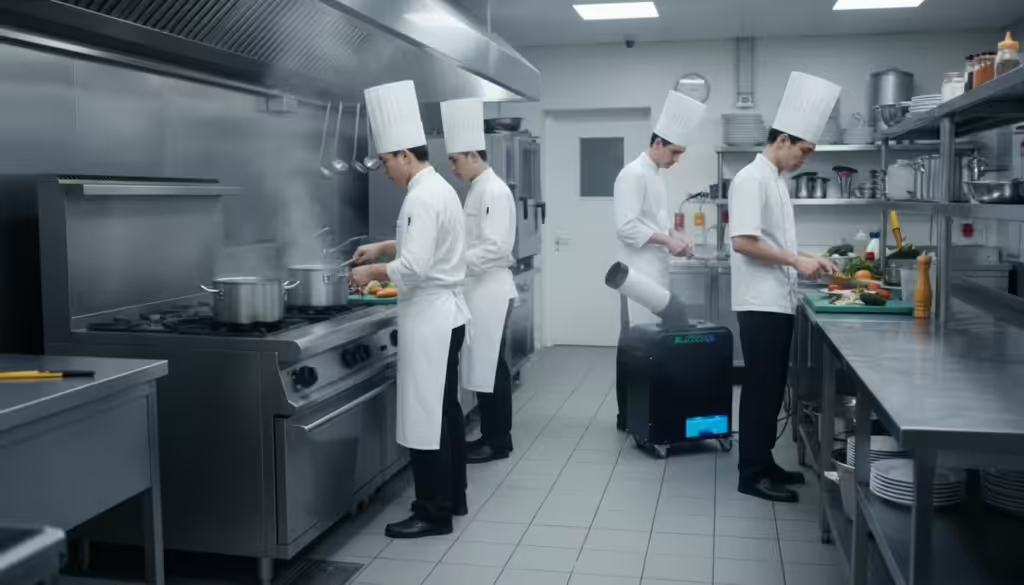
Why does an industrial fan fit better in a professional kitchen?
Beyond flexibility, there are three technical reasons why the industrial floor fan is especially suitable in a professional kitchen environment.
The first is that it doesn’t interfere with the extraction system. Unlike air conditioning, the fan doesn’t try to modify the space’s air temperature: it generates a direct current onto people. Extractors can continue operating at full capacity without affecting the fan’s effectiveness.
The second is environmental resistance. Professional-grade industrial fans are built with motors and structures designed to operate in demanding conditions and during long shifts. In a kitchen with airborne grease, vapors, and intense heat, that robustness makes the difference compared to domestic or low-end equipment that degrades quickly.
The third is operating cost. An industrial floor fan consumes between 60 and 300 W depending on the model. Running during an 8-hour service, the daily electricity cost is less than €0.50. Compared to the cost of air conditioning forced to run at maximum power in a space with active extraction, the difference is very significant.
What to consider when choosing a fan for a restaurant kitchen
Not all industrial floor fans are equally suitable for a professional kitchen. These are the criteria that really matter in that specific environment.
- Actual airflow in m³/h. In a kitchen with active extraction, you need sufficient airflow to generate a noticeable current over the work area. Models with blade diameters from 50 cm and airflow above 5,000 m³/h offer useful airflow even in the presence of currents generated by extractors.
- Motor for continuous use. During restaurant service, the fan may be running for 6 to 10 hours straight. The motor must be specified for continuous use without risk of overheating.
- Ease of cleaning. In a kitchen with oil and grease vapors, the fan accumulates dirt on the blades and grille. A design with removable or easily accessible blades facilitates cleaning and maintains performance over time.
- Mobility. In kitchens where space changes according to service or season, a fan with wheels or portable design allows repositioning without effort.
Reduce heat in your kitchen without construction or complex installations
If you’re looking for an immediate solution, without installation and with low operating cost, the industrial floor fan is the most reasonable starting point for most restaurant kitchens. It doesn’t replace mandatory extraction or eliminate heat from cooking sources, but it really and measurably reduces the thermal sensation on the kitchen team, improves performance during long services, and works without complications in spaces where air conditioning can’t do its job.
At Blizzcool you’ll find a range of industrial fans for restaurant kitchens with different diameters and airflows, designed for continuous use in demanding environments. If you have questions about which model best fits your kitchen’s size and layout, the technical team can guide you before you make the decision.