
On average, a ceiling fan consumes between 15W and 90W per hour, depending on whether it uses a traditional AC motor or a modern low-consumption DC motor. In economic terms, keeping a fan on for 8 hours costs less than €0.05 per day, which is up to 20 times less than a conventional air conditioning system.
In this article, we analyze the real energy expenditure according to the type of motor and how installing an industrial ceiling fan can transform the efficiency of a warehouse or commercial premises, drastically reducing operating costs.
Hourly consumption according to technology type
The electricity consumption of this equipment is not uniform: it is mainly determined by the motor technology and the selected rotation speed.
AC Motors vs. DC Motors
Alternating current (AC) motors usually consume between 60W and 90W at their maximum speed. In contrast, DC (direct current) motors, like those we integrate into our professional range, are capable of moving large volumes of air while consuming barely 5W at their lowest speeds and a maximum of 35-40W.
Estimated energy consumption table for ceiling fans
To understand the impact on your bill, take a look at this comparison based on an average electricity price of €0.20/kWh:
| Device | Consumption (W) | Cost 8h/day | Monthly Cost |
| DC Ceiling Fan | 30W | €0.048 | €1.44 |
| AC Ceiling Fan | 75W | €0.12 | €3.60 |
| Air Conditioning | 2,000W | €3.20 | €96.00 |
If you are looking to maximize performance in large areas, industrial ceiling fans represent the most profitable investment, as they cover areas of up to 200 m² with minimal electricity consumption.
The impact of consumption in industrial environments and large areas
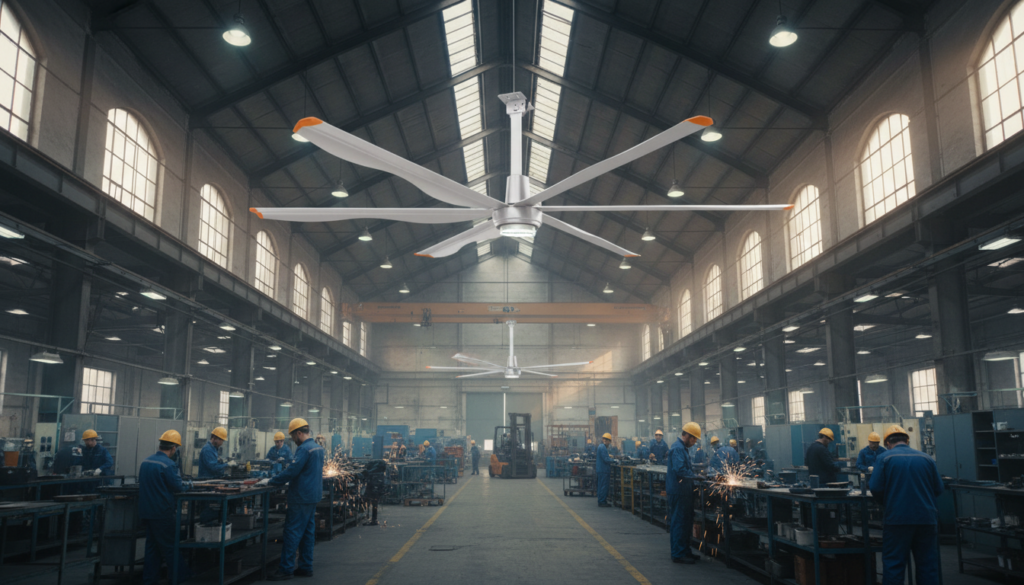
When we talk about industrial buildings, workshops, or warehouses, the consumption calculation changes scale. A common mistake is trying to cool a large space with multiple domestic or pedestal fans.
A single large-diameter industrial ceiling fan (HVLS technology) can move the same amount of air as 30 or 40 small fans. While those 40 small fans would add up to a consumption of nearly 3 kW, a single high-efficiency industrial unit consumes barely 0.4 kW to 0.8 kW.
Savings through uniform heat distribution
One of the greatest benefits of using an industrial ceiling fan is its ability to reduce heating costs during the winter. In high ceilings, heat tends to accumulate at the top. By rotating at low speeds, these units push the warm air down evenly, allowing for savings of up to 30% on the heating bill.
Why choose industrial ceiling fans for your business?
At Blizzcool, we specialize in Brushless DC motors. This technology not only reduces electricity consumption below market standards but also eliminates internal friction, which results in:
-
Zero maintenance: Since there are no brushes, there is no wear from friction.
-
Absolute silence: Ideal for environments where acoustic comfort is key to productivity.
- Precise control: They allow for millimeter-perfect speed regulation to adapt the airflow to the thermal needs of the moment.
Factors that influence how much electricity a ceiling fan consumes
It doesn’t all depend on the motor. There are external variables that determine the efficiency of the equipment:
-
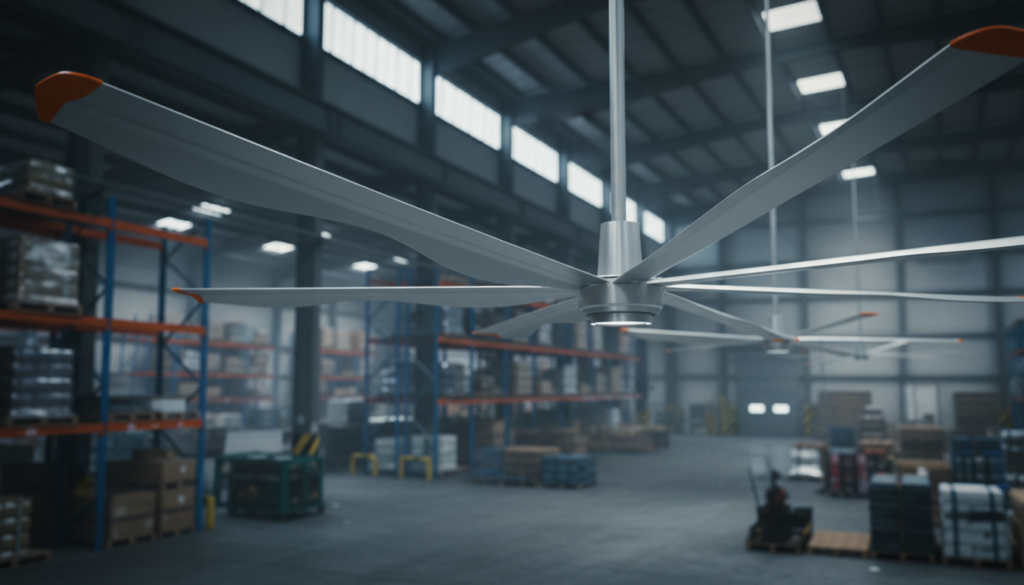
Blade diameter: The larger the size, the more air is moved with fewer revolutions (and less motor effort).
-
Pitch and material: Aerodynamic aluminum blades, found in industrial models, minimize air resistance.
-
Installation height: A fan placed at the correct height optimizes laminar flow, preventing the motor from being overworked.
Improve your warehouse efficiency with Blizzcool industrial fans
Understanding how much power a ceiling fan consumes is the first step toward optimizing your company’s costs. It’s not just about “moving air,” but about creating an intelligent climate control system that works in favor of your profitability.
Our range of industrial ceiling fans is designed to offer a flow rate of up to 55,000 m³/h with industry-leading energy efficiency. If you are looking to reduce your carbon footprint and, at the same time, lower your monthly bills, high-volume, low-speed technology is the ultimate solution.
Discover how Blizzcool’s industrial ceiling fan can transform your workspace into a cooler, more productive, and more economical environment.
