
The main types of climate control systems are air conditioning, evaporative coolers, industrial fans, and misting systems. Each works differently, has a different operating cost, and responds better to certain types of spaces and weather conditions. Understanding these differences is what allows you to make a good choice, both in terms of comfort and energy efficiency.
This guide is designed for anyone managing a space where heat is a real problem: an industrial warehouse, a workshop, a warehouse, a gym, or any facility where the well-being of the people working inside depends directly on how the temperature is managed. If you want to dive deeper into one of the most versatile solutions for these types of environments, industrial floor fans are a good starting point.
What really is a climate control system?
Climate controlling a space doesn’t just mean cooling it down. In a broad sense, climate control is the set of techniques and equipment that allow you to control indoor air conditions: temperature, humidity, and circulation. Depending on the chosen system, you act on one, two, or all three parameters at once.
This matters because the right solution isn’t always the one that cools the most, but the one that best adapts to the conditions of the space and the actual needs of use. A logistics warehouse with cross-ventilation and open doors doesn’t need the same system as a closed server room with constant thermal loads.
Air conditioning: total control, high consumption
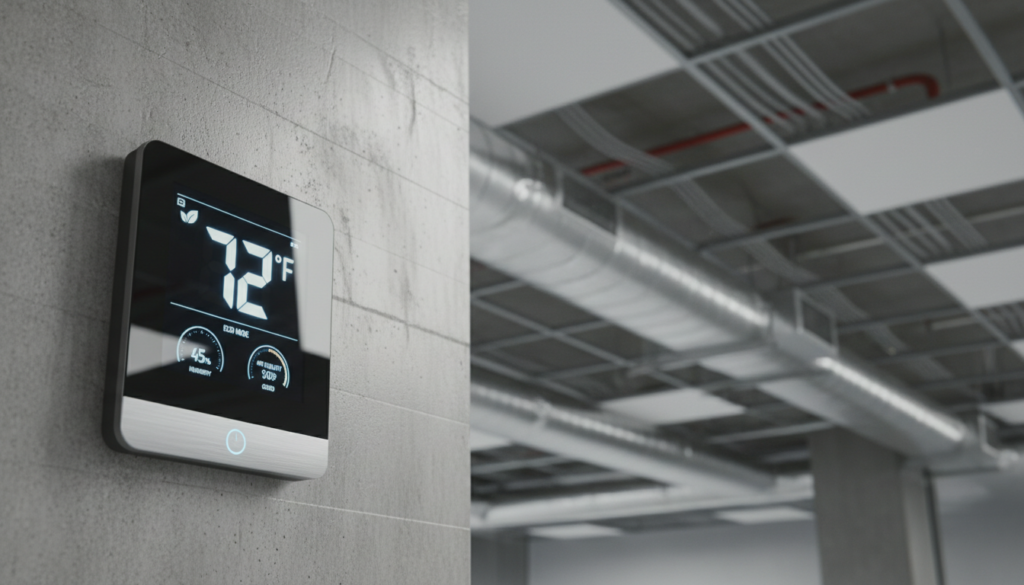
It is the most widespread system. It extracts heat from the interior and expels it outside through a refrigerant compression cycle, actively lowering the ambient temperature. Models with inverter technology adjust power to demand and reduce consumption compared to conventional equipment.
Its main limitation is energy-related: a domestic split unit consumes between 800 and 2,000 W; industrial equipment can exceed 4,000 W. Furthermore, in spaces with high ceilings or constant ventilation, performance drops because the cold air isn’t distributed evenly. It makes sense mainly in closed spaces of controlled size where you need to lower the temperature precisely.
Evaporative coolers: effectiveness in dry climates
They work by passing hot air through wet pads. As the water evaporates, it absorbs heat and the air comes out 5 to 15°C cooler. Without a compressor or refrigerant gases, their electricity consumption is three to four times lower than that of an equivalent air conditioner.
The limiting factor is ambient humidity: they lose effectiveness in humid climates. In dry climates like the Mediterranean or the Spanish interior, where summer humidity is usually below 50%, they are one of the best cost-performance solutions for warehouses, sports facilities, or semi-open spaces.
Industrial fans: low consumption, great coverage
They don’t reduce the air temperature, but they do reduce the perceived temperature. By generating an airflow over the skin, they encourage sweat evaporation and can produce a sensation of several degrees less than the actual temperature, which is especially relevant in physical work environments.
What sets an industrial fan apart is its ability to move large volumes of air continuously and efficiently. A 400 W model can cover hundreds of square meters and run for a full day for less than one euro a day. There are different formats, from large-diameter ceiling fans to wall-mounted and portable ones. If you want to see all the options in detail, the next article on types of industrial fans covers them one by one.
Misting systems: for outdoors and semi-open spaces
They project micro-droplets of water that evaporate in the air before reaching the ground, reducing the surrounding temperature by 5 to 10°C. They are specifically designed for spaces where air conditioning isn’t viable: terraces, loading docks, warehouse entrances, or outdoor sports facilities.
Electricity consumption is minimal, as they only need energy to pump the pressurized water. In high-pressure systems, the droplets are so small that they evaporate completely without wetting people or surfaces.
Which climate control system to choose based on your space
No system is universally better. The choice depends on three factors: the type of space (closed, semi-open, or outdoor), the local climate (dry or humid), and the operating cost you can afford. In high-use facilities, the difference in consumption between industrial air conditioning and a fan or evaporative cooler can mean thousands of euros a year on the electricity bill.
Combining systems is also a common strategy: an evaporative cooler paired with industrial fans that distribute the cool air evenly achieves results close to air conditioning at a fraction of the cost.
Industrial climate control with the solution that fits best
At Blizzcool, we work with warehouses, workshops, storage facilities, and sites where heat is a real operational problem. Our range includes evaporative coolers, misting systems, portable industrial air conditioning, and industrial floor fans, all designed for intensive use. If you’re not sure which system best fits your facility, get in touch and we’ll help you decide.