
For home use, 3 to 5 blades are more than enough, and the difference between configurations is small. In industrial environments or large spaces, 6 blades at low rotation speed is the configuration that best combines airflow, quiet operation, and durability for continuous use.
That’s the short answer, but it’s worth understanding why, because the number of blades is just one of the factors that determine a ceiling fan’s actual performance. If you’re evaluating options for a warehouse or a large space, this guide on how to choose the right ceiling fan provides a complete analysis.
What determines the number of blades on a fan?
Each rotating blade generates a small air turbulence. The blade that follows encounters this turbulent air and uses it less efficiently, meaning that adding blades yields diminishing returns beyond a certain point.
What does change significantly with the number of blades is the rotation speed required to move a given volume of air. More blades mean more swept surface area per rotation, so the motor needs fewer revolutions per minute to achieve the same airflow. Fewer RPMs equate to less noise and less motor wear in the long run.
That’s the logic behind the different formats. It’s not that more blades are always better, but rather that each configuration makes sense in a specific context.
3 blades: maximum speed, ideal for small spaces
3-blade fans are the lightest and offer the least resistance to the motor. This allows them to spin faster and move a significant amount of air for their size, making them especially effective in small to medium-sized rooms where a direct breeze is desired.
Their downside is noise at high speeds. By spinning faster to achieve the same airflow as a fan with more blades, the sound generated by the blades cutting through the air is more audible. For a bedroom or a workspace requiring silence, this can be a drawback.
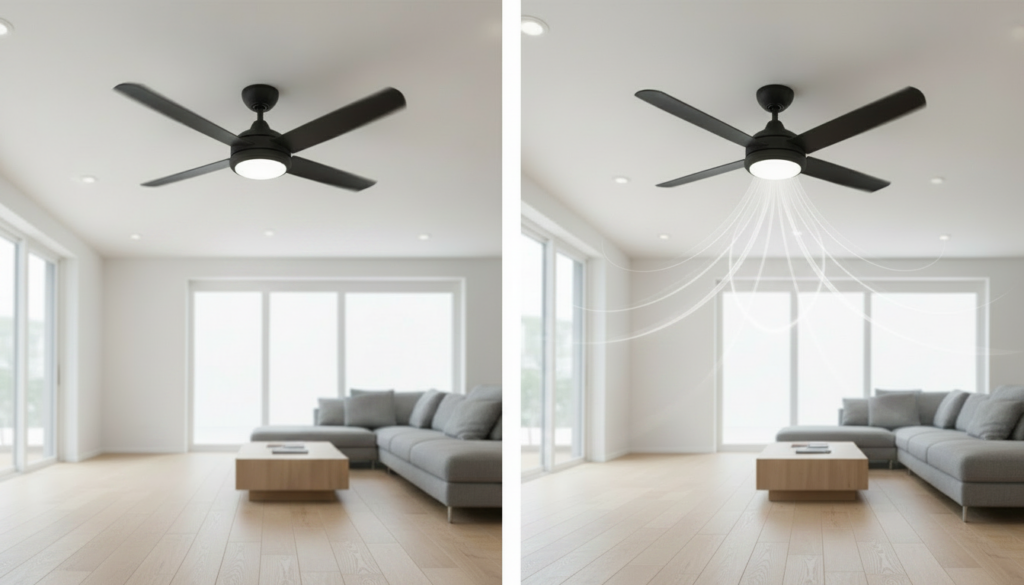
4 and 5 blades: the most common balance for home use
Most domestic ceiling fans use 4 or 5 blades because this configuration best balances airflow, noise level, and overall weight.
A 5-blade fan needs to spin at fewer revolutions than a 3-blade fan to move the same volume of air, resulting in quieter operation. It’s the most common choice for living rooms, medium-sized workspaces, or offices where background noise is a concern.
The practical difference between 4 and 5 blades in a domestic model is very small. For the same diameter and motor, the performance is practically equivalent, and the decision can perfectly be based on aesthetic criteria.
6 blades: for large spaces and continuous use
Beyond a certain diameter and in large spaces, 6 blades allow for a more homogeneous distribution of the swept surface area across the entire circumference of the fan. The result is a more uniform airflow, with fewer concentrated turbulences and sustained working pressure even at low speeds.
In industrial environments, where the fan will operate for entire work shifts, this configuration offers clear advantages: the motor works with less effort per rotation, wear is distributed more evenly, and the noise level during continuous operation is significantly lower than what a 3-blade model moving the same airflow would generate.
Blizzcool’s industrial ceiling fans use 6 blades precisely for this reason. They are designed for warehouses, workshops, and large areas where neither airflow nor quiet operation can be sacrificed, and where the equipment needs to withstand months of uninterrupted use without issues.

Factors that matter more than the number of blades
The number of blades is a secondary criterion compared to other parameters that have a much greater impact on the fan’s actual performance.
- The diameter is the most determining factor. A large fan spinning slowly moves more air and makes less noise than a small fan spinning fast. For spaces over 25 m², the minimum recommended diameter is 150 cm; for industrial spaces of hundreds of square meters, industrial diameters of 200 cm or more are the usual solution.
- The motor type is also crucial. Direct current (DC) motors consume up to 60% less than conventional AC motors and allow for very low minimum speeds, making them especially quiet in night mode or quiet operation. For intensive use in warehouses or professional facilities, they are the most efficient option.
- The installation height affects the fan’s actual effectiveness. Ideally, the blades should be between 2.3 and 2.7 meters from the floor for domestic use. In industrial warehouses with ceilings of 6 meters or more, industrial models are specifically designed to project air much greater distances without losing airflow.
How to choose the right ceiling fan for your space
If the space is a domestic room or a small office, 3 to 5 blades with a DC motor and the appropriate diameter for the square footage is the correct combination. The difference between blade configurations is minimal, and the decision can easily be aesthetic.
If the space is a warehouse, storage facility, workshop, or any installation where the fan will operate for many hours continuously covering large areas, the logic changes: 6 blades, industrial diameter, and a motor designed for continuous use. In these environments, where it may also be necessary to supplement ventilation in specific areas with ground-level air movement, industrial floor fans are a common solution alongside ceiling fans.
At Blizzcool, we work exclusively with industrial ventilation. If you have questions about which configuration best suits your installation, please contact us directly.